
"Kochira de Omeshiagari Desu Ka?" Meaning: Eat In or To Go in Japanese
こちらでおめしあがりですか? (Kochira de omeshiagari desu ka?) = Would you like to eat in?
Eat in: はい。ここで。 (Hai. Koko de.)
To go: いえ、テイクアウトで。 (Ie, teikuauto de.)
Aya is an AI guide character with an AI voice. Credits are at the end.
At a glance
| Who | Japanese | Meaning |
|---|---|---|
| Worker | こちらでおめしあがりですか? (Kochira de omeshiagari desu ka?) | Would you like to eat in? |
| You (eat in) | はい。ここで。 (Hai. Koko de.) | Yes. Eat in, please. |
| You (to go) | いえ、テイクアウトで。 (Ie, teikuauto de.) | No. To go, please. |
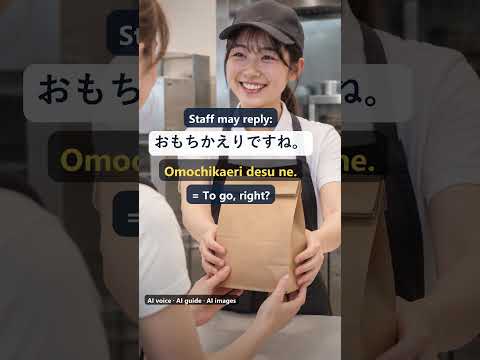
| Worker | お持ち帰りですね。 (Omochikaeri desu ne.) | That's to go, right? |
Next: Irasshaimase: what to say when shop staff welcome you
What it means, word by word
In the Japan Foundation's Irodori textbook, a fast food worker asks this right after you order.
- こちらで (kochira de) = here, at this shop.
- お召し上がり (おめしあがり, omeshiagari) comes from 召し上がる (meshiagaru), a polite verb for eating or drinking. The worker uses it to be polite to you. You don't need to say it yourself.
How to answer
- Eat in: はい。ここで。 (Hai. Koko de.) In Irodori, one customer says just はい (hai = yes), and that works too. ここで (koko de) = here.
- To go: いえ、テイクアウトで。 (Ie, teikuauto de.) いえ (ie) is a short form of いいえ (iie = no). テイクアウト comes from the English word "takeout" (to go, or takeaway in British English).
- Then you may hear: お持ち帰りですね (Omochikaeri desu ne = That's to go, right?). お持ち帰り (omochikaeri) is the polite word for food to go. The worker is checking your order. If that's right, you can say はい (hai).
Price tip
Food to go can be slightly cheaper (8% vs 10% tax, as of November 17, 2026). Japan's National Tax Agency says food and drinks you buy to take away (not alcohol) are taxed at the reduced rate of 8%. Eating at the shop's tables counts as dining out (外食, gaishoku), taxed at the standard 10%. The price may differ, so check the final price on the menu or receipt.
At convenience stores and supermarkets with an eat-in corner, the agency says shops don't have to ask every customer. A sign may simply ask you to tell the cashier if you'll eat inside.
More Japanese for the counter
Quick quiz
You'll eat your food back at your hotel. The worker asks: こちらでおめしあがりですか? What do you say?
A = はい。ここで。 / B = いえ、テイクアウトで。
Comment A or B! (Any language is fine 😊)
Show the answer
B: いえ、テイクアウトで。 (Ie, teikuauto de. = No. To go, please.) A means you'll eat at the shop.
One more note on tax: as of November 17, 2026, a temporary cut in the tax on food is proposed for April 1, 2027 to March 31, 2029. The National Tax Agency says it applies only if the bill passes the Diet (Japan's parliament).
Sources: The Japan Foundation, Irodori: Japanese for Life in Japan, Starter, Lesson 6 (PDF), pages L6-3 (こちらでおめしあがりですか? = Would you like to eat in?), L6-4 (テイクアウトで / ここで / お持ち帰りですね) and L6-15 (the three counter dialogs) / National Tax Agency (in Japanese): Tax Answer No. 6102 (8% and 10%, the planned 2027–2029 cut), Reduced tax rate Q&A, case examples (convenience stores and supermarkets with eat-in space), tax-cut special page. Checked on Nov 17, 2026. Aya is an AI guide character.
Credits: the narration and the Japanese in the video are AI voices, and the counter scenes are AI images (Aya series).


Comments
Post a Comment