
How to Order Food in Japan Without Speaking Japanese: Kore Kudasai
- This oneKore, kudasai. point at the item, the tray or the menu photo
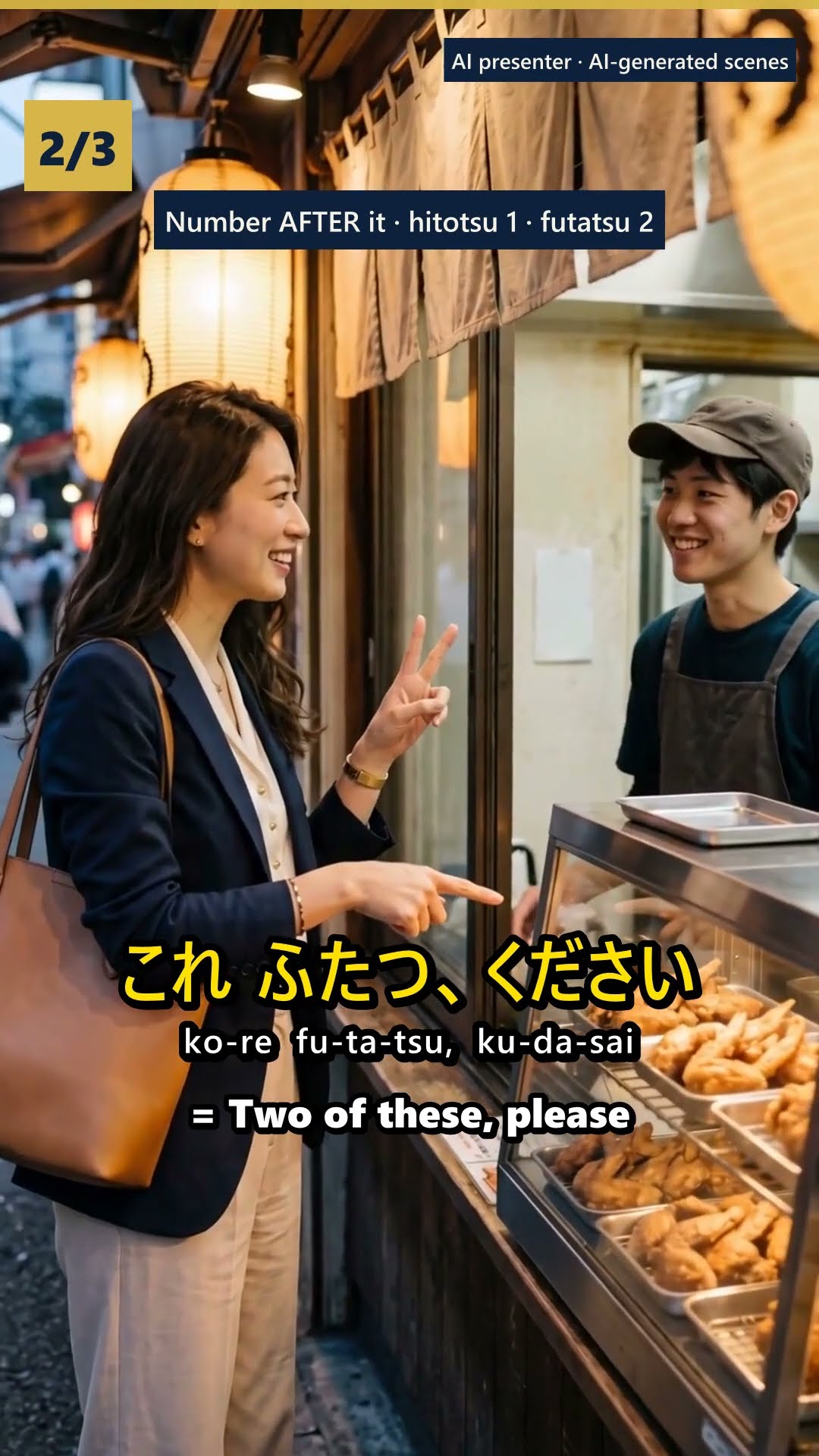
- Two of theseKore futatsu, kudasai. the number goes after the thing
- PoliterKore, onegaishimasu. both are polite; this one asks more gently
Can't read the menu? You don't need to. In many shops, food stalls and restaurants in Japan, you can point and add two words: “Kore, kudasai.” It means “This one, please.” Kore (ko-re) = this, kudasai (ku-da-sai) = please (give me).
Jump to: Ticket machines · Point and order · Numbers · Politer · What staff say · Allergies · Show this screen
First: is there a ticket machine?
Many restaurants and canteens in Japan use a meal ticket machine (shokken) near the door. Then you don't order by talking:
- Put in money and press the button for your dish. Take the ticket.
- Press the change button (おつり, otsuri) to get your change.
- Give the ticket to the staff, at the counter or at your table. It depends on the shop.
Some machines don't take ¥5,000 or ¥10,000 notes; ask the staff to break them. More machines now take electronic payment.
1. Point and say “Kore, kudasai”
No machine? Point at what you want and say “Kore, kudasai.” It works for an item in a showcase, a tray at a food stall or a photo on the menu. Need the staff first? Say “Sumimasen!” (excuse me).
You can also name the thing: “Hotto koohii, kudasai” (hot coffee, please).
2. Add a number: “Kore futatsu, kudasai”
Want more than one? Say the number after the thing: “Kore futatsu, kudasai” = “Two of these, please.” Same with a name: “Edamame futatsu, kudasai” (two edamame, please). For dishes and things, use these numbers, not ichi, ni, san:
- 1 hitotsu (ひとつ) · 2 futatsu (ふたつ) · 3 mittsu (みっつ)
- 4 yottsu (よっつ) · 5 itsutsu (いつつ) · 6 muttsu (むっつ)
- 7 nanatsu (ななつ) · 8 yattsu (やっつ) · 9 kokonotsu (ここのつ)
- How many? ikutsu (いくつ)
3. A little politer: “Kore, onegaishimasu”
Swap kudasai for onegaishimasu (o-ne-ga-i-shi-ma-su): “Kore, onegaishimasu.” Both are polite and both are normal when you order. Onegaishimasu asks the other person more gently, so the textbook calls it the more polite of the two.
Something far away? “Are, kudasai”
Japanese has three words for “this/that”: kore for something close to you, sore for something close to the person you're talking to, and are for something far from both of you. NHK teaches them for asking “What is this?”. Aya's note: the same idea works for ordering, for example a dish on a wall menu: “Are, kudasai.”
What the staff may say
- “Irasshaimase” = Welcome.
- “(Dorinku wa) nani ni nasaimasu ka?” = What would you like (to drink)? Point and say “Kore, kudasai.”
- “Kochira de omeshiagari desu ka?” = Will you eat here? Answer “Koko de” (here) or “Teikuauto de” (takeout).
- “Omochikaeri desu ne” = That's takeout, right?
Water, izakaya and paying
- Sit-down restaurants: water usually comes free with a wet towel (oshibori). Want more? “O-mizu, kudasai.” This is about sit-down restaurants, not takeout counters or stalls.
- Izakaya (Japanese pubs): each person is expected to order a drink, so water isn't served at first, but you can ask for it and it's free. For more food, call the staff and order again. When you finish, ask for the bill and pay at the register.
- “Kore, ikura desu ka?” = How much is this? · “Kaado wa tsukaemasu ka?” = Can I use a card?
Allergies and food you can't eat
Packaged food in Japan must show certain allergens on the label, but restaurant meals and deli food or boxed lunches sold at the counter don't have to, so ask the staff.
- “Kore, ebi ga haittemasu ka?” = Does this have shrimp in it? (swap ebi for the food)
- “Ebi no arerugii desu.” = I'm allergic to shrimp.
- “Nama-tamago wa taberaremasen.” = I can't eat raw eggs.
- “Wasabi wa irenaide kudasai.” = Please don't put wasabi in.
Show this screen
Not ready to say it? Point at the food, then at this.
Use it on the way


Sources
- The Japan Foundation, “Irodori: Japanese for Life in Japan”, Starter, Lesson 6 (PDF): ordering with ください / お願いします, numbers after the thing, counting 1–9, staff phrases, meal ticket machines, izakaya, free water
- NHK WORLD-JAPAN “Easy Japanese”: Lesson 9 (kore / sore / are, taught for asking names) · Lesson 10 (asking prices) · Lesson 19 (“How much?”, paying by card) · Lesson 20 (“don’t put … in”) · Lesson 24 (what you can’t eat)
- The Japan Foundation, “Irodori”, Elementary 1, Lesson 11 (PDF) (asking if a food contains something, allergies, allergy labels)

Hi, I'm Aya. I'm an AI presenter. I show you the hard parts of Nagoya: platforms, exits and tickets. Aya in Nagoya is run by HTS Co., Ltd. in Nagoya. The phrases here follow the teaching materials listed above (opened on the date at the top).
Aya is an AI-generated presenter, and the scenes in the video are AI-generated (not filmed in Nagoya). Cover photos: Osu — xiquinhosilva, CC BY 2.0; Nagoya subway — MaedaAkihiko, CC0, via Wikimedia Commons. This is a phrase guide based on published teaching materials, not a personal review.


Comments
Post a Comment