
Ii desu & Kekkou desu Meaning: "No, Thank You" or "That's Fine"? (Japanese for Travelers)
- No thanksSou desu ka… jaa, ii desu. after you hear the price and decide not to buy
- No, thank youIe, kekkou desu. when you're offered a drink or food you don't want
- … is fineA, koko de ii desu. “Here is fine” — when someone drives you
Short answer: offered something? “Ie, kekkou desu” means “No, thank you” (a polite way to decline). After hearing a price, “Jaa, ii desu” means “Then, no thanks.” But “Koko de ii desu” means “Here is fine”, and “Ii desu yo” to “Is ~ OK?” means “Sure.”
Ii desu (いいです) comes from ii (いい, “good”). Kekkou desu (結構です / けっこうです) also sounds like praise: in the Digital Daijisen, its first meaning as a na-adjective is excellent, without fault. As the kana けっこう shows, say it kek-kou: a short pause before the second “k”, and a long “o”.
Jump to: No thanks (ii desu) · No, thank you (kekkou desu) · Here is fine · How to tell · How to reply · More ways you'll hear it · Show this screen
1. “Ii desu” = no thanks (after a price): そうですか…じゃあ、いいです
At a souvenir shop, a customer in the Japan Foundation's Irodori textbook asks, “Ano, kore, ikura desu ka?” (Um, how much is this?). The clerk says “Hassen happyaku-en desu.” (8,800 yen). The customer answers “Sou desu ka… Jaa, ii desu.” (I see… then, no thanks) and turns it down.
The same lesson explains いいです as No, thank you — an expression used to refuse something, the same as kekkou desu. Here, after the price, “ii desu” means “I'll pass”, and it comes right after “Sou desu ka…” (I see…) and “jaa” (then).
2. “Kekkou desu” = no, thank you (when offered something): いえ、けっこうです
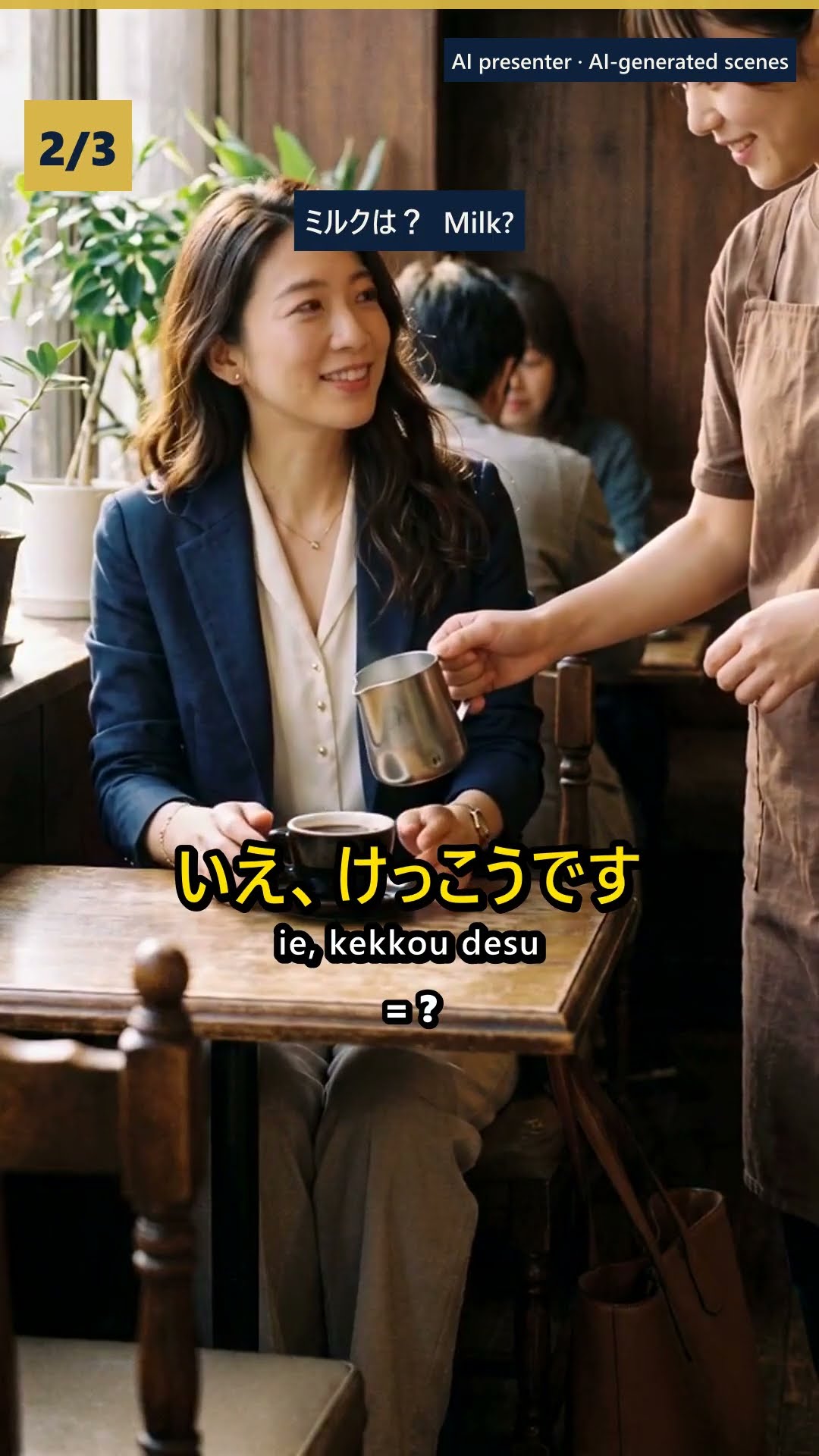
In Irodori (Starter, Lesson 5), someone offers coffee, then asks ミルクは? “Miruku wa?” (How about milk?). The answer: “Ie, kekkou desu.”, translated as “No, thank you.” The textbook teaches it as the answer when you're offered a drink or something else and want to decline. In the video, Aya says it to a café server.
The Nihon Kokugo Daijiten describes this use of 結構 as not needing anything more — used when politely refusing, with the example “Would you like tea?” — “Kekkou desu.”
3. “Koko de ii desu” = here is fine: あ、ここでいいです
Someone is driving you home. When you get to the place you want to stop, say “A, koko de ii desu.” In Irodori (Elementary 1, Lesson 6), Saito-san, a senior colleague, drives Loh-san home, and Loh-san says this; Saito-san asks “E, koko?” (Here?), Loh-san answers “Hai. Koko desu.” and they stop; the textbook translates it as “Here is fine.” It isn't an answer to a yes-or-no question: it means here is fine, you can stop here.
The dictionary Digital Daijisen lists this use of いい (良い): acceptable, allowed, as in 代理人でも良い “dairinin demo yoi” (an agent is fine). In everyday talk, いい is the usual form.
How to tell yes from no
The form matters too. “~ de kekkou desu” means “~ is fine”: the Digital Daijisen example is サインで結構です “Sain de kekkou desu” (A signature is fine). A plain “Kekkou desu” after an offer means you don't need it (“Mou kekkou desu”, That's enough).
How to reply
- Offered something and you want it: はい、お願いします “Hai, onegaishimasu.” (Yes, please.) Irodori teaches this to accept (Starter, Lesson 5). In the Irodori dialogs, ii desu after an offer or a price means no, so if you want it, say hai, onegaishimasu.
- Heard the price and you want to buy it: じゃあ、それ、ください “Jaa, sore, kudasai.” (Then, I'll take that.) That's how the customer buys in the same Irodori shop dialogs (Starter, Lesson 16).
- Offered something and you don't: いえ、けっこうです “Ie, kekkou desu.” (No, thank you.) This is the one Irodori teaches for saying no to an offer (Starter, Lesson 5).
- Asked if a place or time is OK and it is: “Ii desu yo.” In Irodori, “Eki no kaisatsu demo ii desu ka?” (Can we meet at the ticket gate?) is answered “Ii desu yo.” (Elementary 1, Lesson 7).
More ways you'll hear it
- いいですね “Ii desu ne.” = That sounds good (when someone invites you). Irodori Starter, Lesson 12.
- 何でもいいです “Nan demo ii desu.” = I'm fine with anything (when asked what you want to eat). Irodori Elementary 1, Lesson 11.
- 6時半でもいいですか? “Roku-ji han demo ii desu ka?” = Is 6:30 OK? Irodori Elementary 1, Lesson 7.
- At a konbini the clerk may ask こちら、温めますか? “Kochira, atatamemasu ka?” (Shall I heat this up?). In Irodori's dialog the customer says “Hai, onegaishimasu”; in the role-play, the answers to it are “Hai, onegaishimasu” or “Ie, kekkou desu” (Starter, Lesson 16).
- けっこう as an adverb means fairly, rather (Nihon Kokugo Daijiten: かなり): けっこう高く売れる “kekkou takaku ureru” = sells for a fairly good price (Irodori Elementary 2, Lesson 12). This one isn't a yes or a no.
Quick questions
Is “kekkou desu” polite? The dictionary says this use is for declining politely, and Irodori teaches “Ie, kekkou desu” for offers.
Kekkou or kekko? The word is けっこう, with a long “o”: kekkou. Some spell it “kekko”, but the vowel is long.
“Ii desu ne” or “Ii desu yo”? “Ii desu ne” answers an invitation: that sounds good (Irodori Starter, Lesson 12). “Ii desu yo” answers “Is ~ OK?”: sure (Elementary 1, Lesson 7). To say no to an offer yourself, Irodori teaches “Ie, kekkou desu.” (Starter, Lesson 5).
Show this screen
Point at the line you need.
Use it on the way

Sources
- The Japan Foundation, “Irodori: Japanese for Life in Japan”: Starter Lesson 5 (PDF) (“Miruku wa?” — “Ie, kekkou desu.” No, thank you; accepting with “hai, onegaishimasu”) · Starter Lesson 12 (PDF) (“Ii desu ne.”) · Starter Lesson 16 (PDF) (souvenir shop: “Sou desu ka… Jaa, ii desu.”; いいです = No, thank you, the same as けっこうです; convenience store role-play) · Elementary 1 Lesson 6 (PDF) (“Koko de ii desu.” Here is fine.) · Elementary 1 Lesson 7 (PDF) (“… demo ii desu ka?” — “Ii desu yo.”) · Elementary 1 Lesson 11 (PDF) (“Nan demo ii desu.”) · Elementary 2 Lesson 12 (PDF) (“kekkou takaku ureru”; the adverb is explained as かなり in the Nihon Kokugo Daijiten; the English is our translation)
- Shogakukan “Digital Daijisen” and “Nihon Kokugo Daijiten” (Seisenban), entry 結構 (including the adverb かなり in the Nihon Kokugo Daijiten) on Kotobank; “Digital Daijisen”, entry 良い (よい; いい in everyday talk) on Kotobank

Hi, I'm Aya. I'm an AI presenter. I show you the hard parts of Nagoya: platforms, exits and tickets, and the Japanese you'll need. Aya in Nagoya is run by HTS Co., Ltd. in Nagoya. The phrases here follow the teaching materials and dictionaries listed above (opened on Oct 20, 2026).
Aya is an AI-generated presenter, and the scenes in the video are AI-generated (not filmed in Nagoya). This is a phrase guide based on published teaching materials, not a personal review.


Comments
Post a Comment